How Cowboy Clean Fuels is Turning Wyoming’s Coal Country into a Carbon Storage Powerhouse

During Climate Vault Solutions RFP round for Innovative Carbon Dioxide Removal (CDR) projects, our Technology Experts Chamber selected the first biomass carbon removal and storage (BiCRS) project in our portfolio — and one of only six projects to pass our rigorous selection process to date.
Picture this: a team of researchers, armed with over a decade of scientific discovery and a bold vision, transforming Wyoming’s deep coal formations into permanent carbon storage. But our new CDR portfolio project, Cowboy Clean Fuels, isn’t just removing carbon from the atmosphere; it’s reinventing legacy energy infrastructure to produce renewable natural gas — turning what was once underground into a cleaner future above ground.
We sat down with Ryan Waddington, CEO of Cowboy Clean Fuels, to learn more about their mission to deliver permanent carbon removal while transforming Wyoming’s Powder River Basin into a source of renewable natural gas — through a patented process born from over a decade of university research.

Cowboy Clean Fuels traces its roots to nearly two decades of University of Wyoming research. How did that science make it out of the lab and into a commercial operation — and what made you the person to do it?
The researcher behind the science is my Cowboy co-founder, Dr. Michael Urynowicz. After years of laboratory work at the University of Wyoming, Michael was approached by a small Wyoming energy company to conduct a field demonstration in 2019. That project served as the ultimate proof of concept, proving that what worked in the lab also worked in the field. It was at this point that Michael began to consider commercialization. Having been friends since we earned our Master’s degrees in Environmental Engineering together in the mid-90s, he reached out to me.
While Michael brought the science, my background was in early-stage investing within the energy and climate tech sectors. I had already been involved with dozens of university spin-outs throughout my career. When Michael called me in early 2020, I suspect he expected me to help him license the technology to a major energy corporation. However, once I saw the data, I realized it was a perfect fit for the emerging Voluntary Carbon Market (VCM). Given the scale of the climate challenge and the opportunity the VCM presents, I told Michael we had to build a company around his innovations. He trusted my vision, and we were off to the races.
For someone encountering BiCRS for the first time, how would you explain what Cowboy Clean Fuels does and why it matters?
The simplest way to explain what we do is this: We leverage natural systems and legacy infrastructure to return atmospheric carbon to the subsurface for permanent storage.
A slightly longer explanation is this. Plants remove CO2 from the atmosphere and convert it into carbohydrates. Agricultural by-products containing those carbohydrates can be solubilized and injected into certain deep geologic coal formations that historically held significant quantities of fossil fuels, like natural gas. These injection processes utilize legacy energy production assets to enable access to geologic formations.
Once in the subsurface, native microbes break down the solubilized agricultural by-products into CO2 and methane. While the bio-methane freely moves through the formation and can be produced to the surface to offset fossil fuel use, the CO2 is immediately adsorbed to the geologic coal formation and is permanently sequestered with 1,000+ year durability.
This approach matters for three reasons:
- First, the durability and permanence of the removal and storage methodology is second to none.
- Second, capital costs are lower than any other BiCRS technology, thereby reducing the barriers to deployment.
- And third, the scalability of the solution is massive.
Cowboy’s first project will result in ~300,000 MT of net CDR credits per year itself, and the potential exists for dozens of other projects of that size to be built in the same region of Wyoming — not to mention the potential in other areas around the world, including Canada, Europe, Australia, China, and Vietnam.
What was the inspiration behind Cowboy Clean Fuels’ unique BiCRS+RNG approach? How did that dual-value model come together, and what does it mean for buyers of carbon removal credits?
The approach derives directly from the natural systems, native biology, and geology that exist in specific regions, like the Powder River Basin in Wyoming. Nature often shows us the way to solve problems, if we pay enough attention to see it. In the case of BiCRS+RNG, we leverage photosynthesis, methanogenesis, adsorption, and other natural processes that we didn’t need to engineer or create ourselves. The inspiration to combine these natural systems with legacy energy assets and the existing agricultural value chain was a product of innovative thinking and smart engineering — supported by a healthy portion of trial and error.
The dual-value model is part and parcel with the technology itself. Methanogenesis, by its very nature, produces both CO2 and methane (CH4). While it is possible to leave the bio-methane in the ground, sequestered, just like the CO2, our belief is that we can have an additional positive impact by bringing it to the surface.
For CDR credit buyers, the benefit is that they are helping bring carbon-neutral RNG to market, where it can directly offset the use of fossil fuels. There is no single silver bullet to addressing climate change. In our view, the energy transition to lower carbon fuel sources must be pursued along with decarbonization through high quality CDR. Cowboy’s BiCRS+RNG technology is the only approach we know of that offers both in a single solution.
High-integrity measurement, reporting, and verification (MRV) is increasingly a make-or-break issue for buyers. How does Cowboy Clean Fuels approach MRV, and why should buyers feel confident in the credits you’re generating?
We believe that integrity and trust are the critical factors required for the voluntary CDR market to grow. That requires transparency and straightforward carbon accounting and verification — requirements our process was designed to support from the start. Buyers who value quality and durability, like Climate Vault Solutions, can feel confident in purchasing Cowboy CDR credits because every aspect of our projects is auditable with real, measured, and third-party analyzed data.
Buyers can also move forward without significant concern for reversals because we account for 100% of our embodied emissions upfront. We do not amortize them over years or decades like some other project developers. This approach ensures that the number of CDR credits a buyer purchases exactly represents how much net carbon has actually been removed, from year one of a project onward.
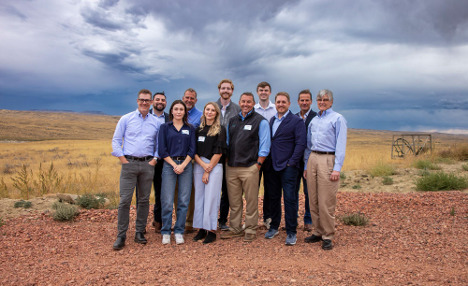
Cowboy Clean Fuels team
In the carbon removal space, there are many promising solutions that haven’t yet made it to commercial scale. What has the journey from concept to an operational, credit-generating project looked like for Cowboy Clean Fuels? What have been some key milestones or breakthroughs for your team?
Commercially, Cowboy’s journey has been somewhat atypical. As I mentioned earlier, our story truly began about 20 years ago in the lab at the University of Wyoming. However, even since Cowboy’s founding, we have taken an approach that differs significantly from many of our peers. Compared to others in the space, we have not raised a vast amount of capital, and none of it has come from venture capitalists.
With technology as unique as ours, I recognized early on that we wouldn’t fit the traditional VC model. Instead, we sought out individual investors with deep entrepreneurial and energy experience. We knew these investors would understand the journey we were on and be able to withstand the inevitable ups and downs. Their support has been critical to our success to date.
By contrast, our operational journey over the past six years has looked fairly conventional. We’ve been able to leverage the collective experience and capabilities of Wyoming’s energy and agricultural industries. Our operations team brings years of experience to everything we do, and our unit operations do not require regulators to step outside their comfort zone. The fact that we have been generating removals for over a year, while companies that started at the same time are still years away from generating credits, is a direct result of our ability to keep our operations and regulatory strategy as straightforward as possible.
Wyoming’s Powder River Basin is central to your project. What makes this region so well-suited to what you’re trying to accomplish? What would it take to replicate your model beyond Wyoming to mitigate climate change on a global scale?
The Powder River Basin (PRB) is a region with a long and prolific history of meeting the energy needs of our country and the world. Coal, oil, natural gas, and uranium have all been produced here for decades. More recently, the region has become a source of rare earth elements and a home for wind and solar developments. This legacy is primarily a function of geology, but it has also yielded a robust infrastructure, a strong local supply chain, and a skilled workforce. Wyoming and the PRB have always provided what the world needed, and now the next chapter is being written. Only this time, the world needs clean energy and climate-positive solutions. The same geology, infrastructure, and workforce that were critical to the past are exactly what is needed for this next chapter. That is why the PRB is so well-suited to our process.
While there may be no better place to deploy our technology, there are many other regions that are just as capable. The most important requirement for global deployment of our process is the presence of geologic formations with native methanogenic microbial communities and the ability to sequester carbon via adsorption. Infrastructure, supply chains, and local feedstock availability are also critical. The good news is that we have already identified several other locations around the world that meet these requirements. Replicating our model in these locations to mitigate climate change on a global scale is simply a function of capital and time. With the success of our first project in Wyoming, we are not far away from making this a reality.
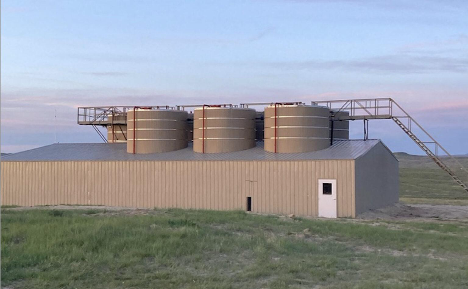
Cowboy Clean Fuels’ Triangle Unit project in Wyoming
You now have an exclusive supply agreement with Climate Vault Solutions. What made CVS the right commercial partner, and what does independent scientific validation from the Tech Chamber mean for how you bring credits to market?
CVS is the right commercial partner for us because we fundamentally share the same values and vision. They understand and appreciate both the uniqueness of the Cowboy process and the importance of bringing it to market for the benefit of CDR credit buyers. They approached us with an open mind and brought in their Tech Chamber experts to evaluate us on our technical merits and potential for real impact. These experts have unmatched scientific credentials alongside real-world experience. This combination gives them an unparalleled perspective on not just which technologies can work, but which technologies should be supported because they can truly make an impact.
We believe that as the voluntary carbon removal market continues to mature, increasing importance will be placed on solutions like Cowboy’s; those that are both scientifically sound and highly impactful. The Tech Chambers’ validation means we can bring our credits to market for the benefit of buyers who value quality, durability, and scalability.
Looking ahead, what does success look like for Cowboy Clean Fuels over the next five to ten years, and what needs to happen — across policy, markets, and technology — to get there?
Success for us over the next five to ten years means, first and foremost, fully scaling our first project and contracting for the offtake of our CDR credits in partnership with CVS. It also means developing additional projects and bringing more credits to market — ideally continuing that partnership with CVS. We also have clear plans to reduce our feedstock costs and broaden the types of feedstock we can utilize, which will expand the scope and scale of the BiCRS+RNG opportunity.
Ultimately, success for Cowboy is linked to success for the entire market and to success for the climate. We need more novel technologies like ours, alongside larger and more mature markets. Better policy support can’t hurt either. We at Cowboy are optimistic that success is possible — for us, for the market, and for the climate. Especially with partners like CVS that share the same vision and values.
Secure high-quality, permanent carbon removal from Cowboy Clean Fuels. View availability, pricing, and delivery timelines to assess fit for your Net Zero targets: